Lagoon Invertebrates
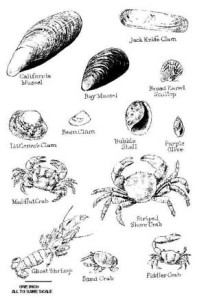
Of the invertebrates occurring in the lagoon, the more common and interesting ones are illustrated in Figure 4. The Bay Mussel, which attains a length of 4 inches, is wedge shaped and blue black. It is found attached by long fibrous threads to the pilings of the railroad bridge and to the rip rap near the northern beach parking lot. This is the “edible” mussel, prized by seafood connoisseurs. However, potential consumers of the Bay Mussel and the related open coast California Mussel are warned not to eat them during the summer months. At this time Public Health authorities proclaim that their flesh may be poisonous because the food of the mussel may include noxious microscopic “red tide” planktonic organisms which occasionally flourish during the warmer months.
The Common Littleneck Clam has many well developed radiating ribs and a few, less prominent, concentric ridges. The exterior is white to yellow or tan with or without V-shaped brown markings. This clam may reach a size of 3 inches and typically is found buried in black muddy sand.
The Jackknife Clam resembles a long and narrow whitish gray pocket knife, in life partially covered by tough brown skin. This covering protects the shell from dissolution from acid conditions in the sediments. It is rare to common and is used as fish bait locally. This clam was much more abundant during earlier periods as indicated by the many empty shells in the sediments.
The Striped Shore Crab is dark green with numerous wavy stripes along its back. This is the largest of the common lagoon crabs, reaching 3 inches in width, and often may be seen scurrying about out of water, scavenging for food.
The Mud flat Crab is smaller than the Shore Crab, and can be readily distinguished from it by the yellowish buff color, and by the presence of many hairs on the walking legs.
The Fiddler Crab is slightly smaller than the Mud flat Crab and is easily recognized from the others by its stalked eyes and by the one large claw brandished by the males. During courtship this claw is waved back and forth, thus suggesting the crab’s name.
Next topic: Lagoon Mammals