Bee Monitoring Project
Welcome to the Homepage of the Torrey Pines Bee Inventory and Monitoring Project!

This is a collaborative project of UC San Diego Natural Reserves System, the Torrey Pines Docent Society, and the Pollinator Lab at the University of Oklahoma. The goal of this project is to use photography to document and monitor the native bee species that occur in Torrey Pines State Natural Reserve. Anyone with a smartphone or camera can participate in the project, and we would love for you to join us!
Background

We are losing biodiversity worldwide at an alarming pace. Habitat loss, climate change, and environmental pollution are some of the leading causes of this biodiversity loss. Here in San Diego, much of the native scrub and chaparral habitat have been converted into urban landscapes, leaving only little pockets of natural habitat remaining, mostly in protected areas. Torrey Pines State Natural Reserve is one of the best preserved patches of native habitat along the heavily developed coast of San Diego, and as such, serves as an important sanctuary of biodiversity for many organisms, including native bees.
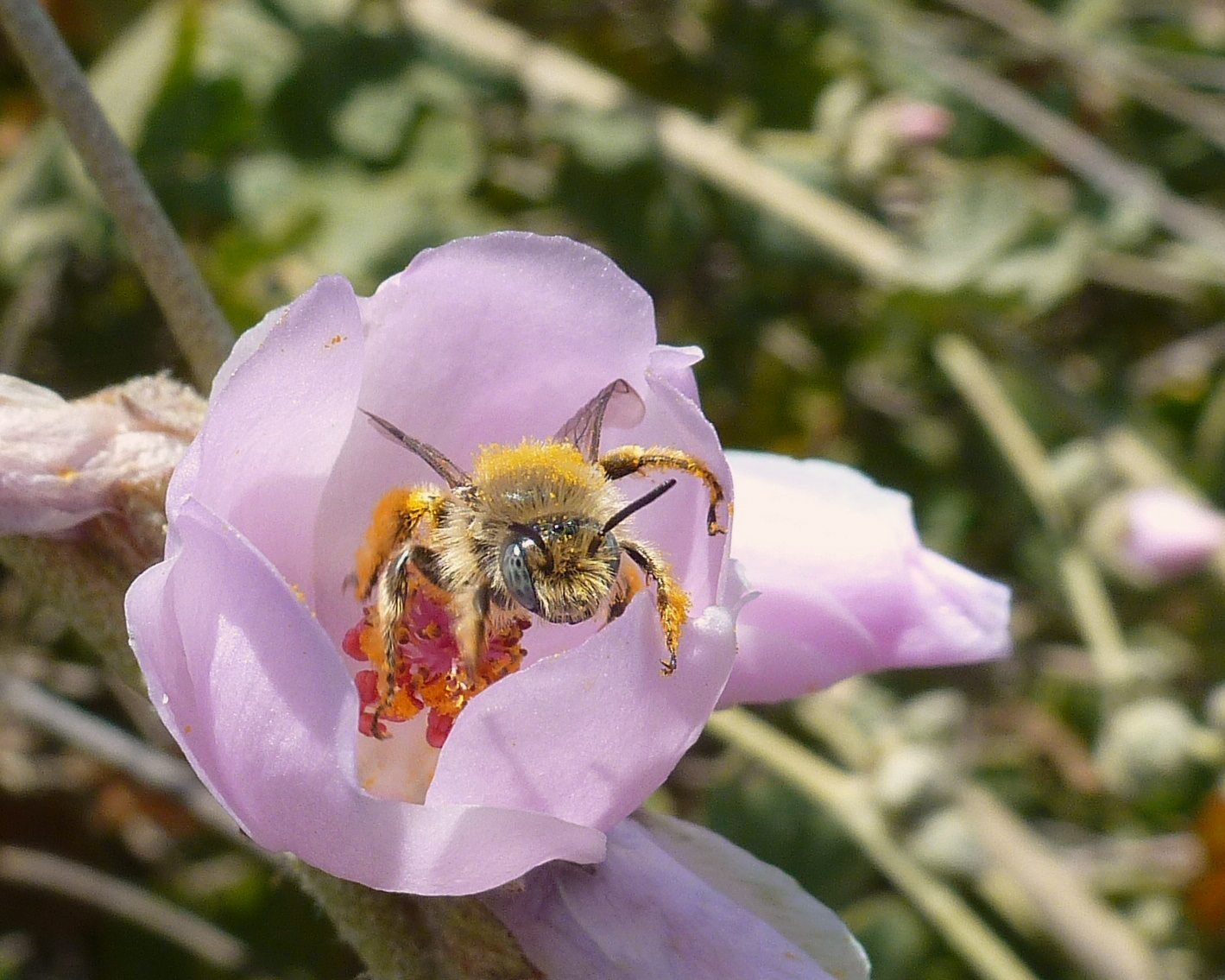
Native bees are among the most important pollinators in the world. They are especially important here in San Diego, where many of the foundational native plant species are insect pollinated. And so, we need to properly monitor and protect our native bees. To date, most monitoring efforts involve systematically collecting bees, as many bee species require examination of microscopic features for identification. However, in recent years, with the improvement of photography equipment and advancements in bee identification techniques, it has become possible to identify bees to the genus and species level from photographs taken in the wild.
This is where our project participants come in! Community members who take photographs of flora and fauna and upload them to community science platforms like iNaturalist.org are becoming an increasingly formidable source of natural history and ecological data. In this project, we hope to harness the collective interest of the Torrey Pines community to help monitor bees in the Natural Reserve.
How the Project Works
Click here to see the full step-by-step protocol to join the project and start collecting bee monitoring data!
The basic process of how the project works is as follows:
1. Project participants walk along defined monitoring routes and take photographs of bees encountered.
2. Project participants upload photographs of bees onto iNaturalist, with specific data fields filled in to allow researchers to find the data.
3. Project researchers and other taxonomic experts identify the bee photographs to the finest resolution possible.
4. Project researchers catalogue the bee species observed by project participants, and monitor their population trends, timing of activity, and distribution within the park.
Click here to see details about the monitoring routes.
Join the Project!
Participation in the project is designed to be accessible to a wide audience. Anyone who has access to the internet and a camera or a smartphone with a decent camera (most phones less than 5 years old) can participate, and there is no recurring commitment requirement. You may enjoy participating in the project if you…
- Enjoy hiking in Torrey Pines
- Enjoy observing plants and insects in their natural habitat
- Like taking photographs
- Have basic skills in operating computers or smartphones
To participate, please first read the step-by-step protocol by clicking here.
Current inventory of the bees of Torrey Pines State Natural Reserve
Click here to see the current bees of Torrey Pines inventory on iNaturalist.org!